There is a specific type of real estate opportunity that serious investors learn to recognise over time. It is not the market that everyone is already talking about. It is the market where the fundamentals are firmly in place, the infrastructure is credibly committed, the institutional developers have quietly entered, and the general public has not yet caught up.
Karjat, in August 2026, is exactly that market.
Situated 90 kilometres from Mumbai in the green folds of the Western Ghats, Karjat has spent decades being appreciated as a weekend destination. Waterfalls, rivers, mountain views, and a cooler climate made it a natural escape from the density of the city. But what is happening in Karjat right now goes well beyond leisure. Three major infrastructure projects are converging. India’s largest real estate developers have committed capital. The government has formally included Karjat in its biggest urban development programme since Navi Mumbai. And land prices, while already appreciating at over 50% in three years, are still accessible compared to comparable markets like Lonavala and Alibag.
Here are the five reasons this market deserves serious attention before the end of 2026.
Reason 1: Mumbai 3.0 Has Officially Put Karjat on the Map
In October 2024, the Maharashtra government designated MMRDA as the development authority for Mumbai 3.0, also known as the Karnala-Sai-Chirner New Town. This greenfield urban programme covers 124 villages across Uran, Pen, Panvel, and Karjat in Raigad district, spanning approximately 323 square kilometres. Chief Minister Devendra Fadnavis chairs the MMRDA board directly.
The numbers behind Mumbai 3.0 are not incremental. MMRDA has committed a total infrastructure outlay of Rs.48,072 crore. CIDCO has floated infrastructure tenders worth over Rs.6,000 crore. Blackstone Group has committed 11 billion US dollars in Maharashtra, with 5 billion dollars specifically earmarked for the Mumbai 3.0 corridor. Singapore-based Surbana Jurong was appointed as master planner in August 2026, with the blueprint expected in Q1 2027. Five international universities have signed Letters of Intent for the education city component of the programme.
What does this mean for Karjat specifically? The government’s stated vision positions Karjat as the nature-integrated, hillside counterpart to the urban and commercial density that will build around the Navi Mumbai International Airport. Knowledge parks, eco-sensitive residential development, and tourism infrastructure are part of the explicit mandate. This is not a peripheral benefit. Karjat is inside the zone, and the planning authority is one of Maharashtra’s most powerful.
For real estate investors, the principle is straightforward. When a credible government programme of this scale formally designates a zone for development, land values in that zone begin re-rating even before a single brick is laid. That re-rating is already beginning in Karjat. But with the master plan not yet published, the full pricing impact is still ahead.
Reason 2: The Panvel-Karjat Rail Line Is Going to Change Everything for Residential Real Estate
This is the single trigger that will most directly transform Karjat’s residential property market, and it is arriving within months.
The Panvel-Karjat suburban rail corridor is a 30-kilometre route with five stations at Panvel, Chikhale, Mohape, Chowk, and Karjat, budgeted at Rs.2,782 crore and built by MRVC. As of August 2026, the project is over 50% complete. Central Railway is expected to take possession of the line around October 2026, with passenger services targeted by December 2026.
Once this line is operational, Karjat connects to Panvel in approximately 40 to 45 minutes by suburban rail. From Panvel, the entire Mumbai suburban rail network is accessible. The commute equation for a Mumbai or Navi Mumbai professional considering a home in Karjat changes fundamentally. What was previously viable only as a weekend destination becomes a genuine daily-commute address.
Every expert interviewed for this report made the same observation. Mahesh Bhoir of Aaradhy Real Estate noted that land demand is already strong driven by the second home market. R K Infra and Realtors were direct: residential demand will gain significant momentum once the rail line becomes operational. The plot market is already active and strong, but residential housing is expected to grow alongside it as rail connectivity establishes Karjat as a permanent residential address.
The investor implication is clear. If you are considering a residential apartment or residential plot in Karjat, you are currently at the pre-rail price point. Once the first passenger service runs and commuter demand becomes visible and measurable, prices will re-rate. The window to enter at pre-appreciation prices is December 2026 or before.
Reason 3: South Mumbai to Karjat in Under 1.5 Hours Is Now a Real Possibility
For most of the past decade, the distance between South Mumbai and Karjat was psychological as much as physical. The 90-kilometre road journey took 2 to 2.5 hours in good traffic and considerably longer on a weekend evening. That reality kept Karjat firmly in the weekend-only category for South Mumbai buyers, regardless of how attractive the location was.
Two infrastructure projects are changing this calculation permanently.
The Atal Setu, India’s longest sea bridge at 21.8 kilometres, was inaugurated in January 2024. It connects Sewri in South Mumbai to Nhava Sheva in under 20 minutes. This single project has compressed the perceived and actual distance between South Mumbai and Navi Mumbai dramatically.
Combined with the Panvel-Karjat suburban rail line, the multi-modal journey from South Mumbai to Karjat via Atal Setu and rail is estimated at approximately 1 hour 20 minutes to 1 hour 40 minutes once all links are fully operational. For most South Mumbai addresses, door-to-door travel time to Karjat falls into the 1.5-hour bracket.
To put this in perspective: Pune is approximately 3 hours from South Mumbai by road. Alibag is 1.5 to 2 hours via the Ro-Ro ferry on a good day and significantly longer by road. Lonavala is 2 hours on the Expressway. Karjat, with rail connectivity and Atal Setu, is now the most accessibly connected nature-retreat destination from South Mumbai in the entire MMR geography.
This is the piece of information that most South Mumbai buyers have not yet fully absorbed. When they do, the demand wave from Worli, Prabhadevi, Lower Parel, and Bandra for Karjat second homes will be meaningful.
Reason 4: NA Plots Are Delivering Real Returns and the Rate Cycle Is Still Accessible
Let us talk numbers.
NA plots on the Radisson Blu Road corridor in Karjat are currently transacting at Rs.3 to 6 lakh per guntha, where one guntha equals 1,089 square feet. Translated to a per-sqft rate, this is approximately Rs.2,750 to Rs.5,500 per sqft. A-grade NA plots near the station belt and on prime road frontage near Saltt restaurant are at Rs.4,000 to Rs.6,000 per sqft.
According to 99acres verified listing and transaction data, land appreciation in Karjat has exceeded 50% over the past three years and 87.5% over a ten-year holding period. These are not speculative figures. They are drawn from actual listing and transaction data on India’s largest property portal.
The FSI applicable to NA plots in Karjat is 1.1. This means a buyer who acquires a 2,000 sqft NA plot can construct up to 2,200 sqft of built-up area. The low FSI keeps construction density down and preserves the open, nature-oriented character that drives Karjat’s premium in the second home and villa market.
Kedar Mande of Universal Properties puts it directly: NA plots have good traction and will continue to deliver strong returns. Investors primarily seek land with good road access, proximity to the station belt, or adjacency to the hospitality corridor near the Radisson Blu. These locations consistently outperform peripheral land.
Compare Karjat’s current NA plot rates to Lonavala, where comparable plots are at Rs.8,000 to Rs.15,000 per sqft, or Alibag, where waterfront plots routinely exceed Rs.10,000 per sqft. Karjat is delivering comparable or superior natural assets and infrastructure trajectory at a fraction of those rates. That differential does not typically persist once the infrastructure story becomes mainstream knowledge.
Reason 5: Three of India’s Biggest Developers Have Already Voted with Their Capital
In real estate, there is no more credible market signal than institutional developer entry. Kalpataru, Godrej Properties, and Lodha do not commit land acquisitions and launch inventory in markets without multi-year demand and infrastructure due diligence. The fact that all three are simultaneously active in Karjat in 2026 is the clearest possible institutional endorsement of this market’s forward trajectory.
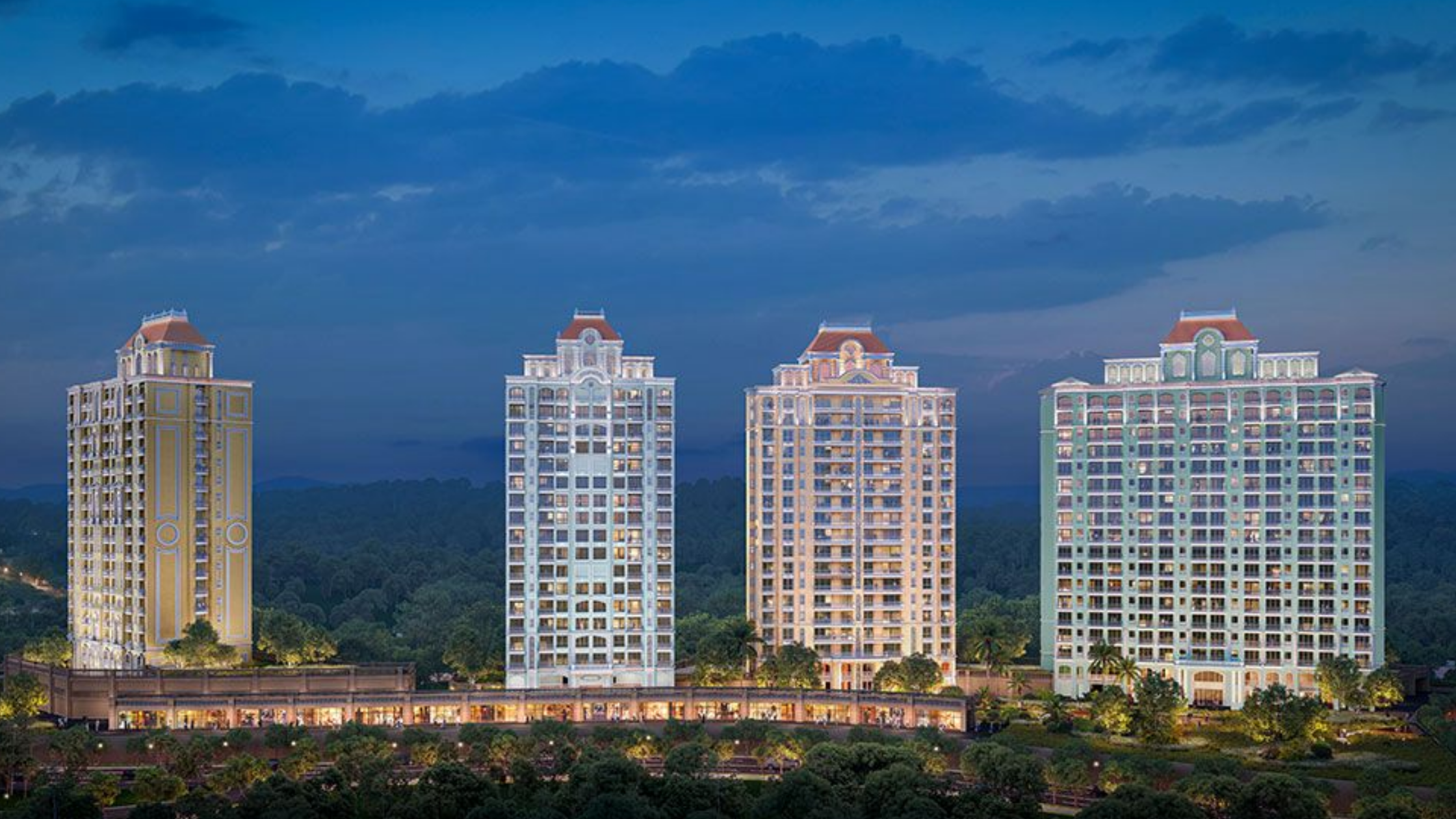
Kalpataru’s Aria project is an 18-acre gated township offering 2 and 3 BHK villas and a newly launched apartment component called Residences at Kalpataru Aria. Entry pricing begins at Rs.69 lakh. The project includes mountain views, resort amenities, pool, and gym infrastructure consistent with Kalpataru’s premium positioning.
Godrej Properties has launched Woodside, a plotted development in the Karjat corridor with nature-integrated design and the Godrej brand’s guarantee of clear title and institutional quality control. For buyers who have historically been concerned about title risk in smaller markets, the Godrej name is a meaningful assurance.
Lodha has entered with Cero, its nature-retreat product for the Karjat second-home segment. Lodha’s decision to build a Karjat-specific product line signals that the company sees sufficient high-net-worth demand to justify the inventory risk.
Beyond the big three, Aura Land is active in NA plotted development, and Assent Basalt Bungalow caters to the luxury end of the gated bungalow market.
Kiran Dhole of Samyak Projects sums it up: Karjat will benefit from multiple infrastructure projects converging simultaneously. It is a good time for investors to consider land and residential properties, especially in areas near the Radisson Blu corridor where the amenity ecosystem is the strongest in the region.
Where Exactly Should You Buy in Karjat
Based on the field data, expert interviews, and developer project analysis in our August 2026 Karjat Market Newsletter, the five micro-markets rank as follows for investment:
The Radisson Blu Road belt is the premium second-home zone. Five-star hospitality adjacency, celebrity farmhouses, and Kalpataru-Godrej developer presence make this the highest-confidence NA plot investment zone. Rate: Rs.4 to 6 lakh per guntha.
The Station belt near Saltt restaurant is the residential investment zone. Post-rail, this area captures commuter-driven apartment and residential plot demand. Rate: Rs.4,000 to Rs.6,000 per sqft. Best for 3 to 5 year residential hold.
Bhivpuri Road is the scenic villa zone. River-touch plots, waterfall proximity, and HNI weekend home demand make this a strong buy for lifestyle investors. Rate: Rs.3 to 5 lakh per guntha.
Tata Road and the ND Studios belt offer larger agricultural land parcels and farmhouse potential at more accessible rates of Rs.1.5 to Rs.3 lakh per guntha for a 5 to 8 year strategic hold.
The residential apartment market across these zones, currently at Rs.22 lakh to Rs.50 lakh for 1 and 2 BHK configurations, is a pre-rail entry play that will respond sharply to commuter demand once December 2026 arrives.
Karjat is not a speculative bet. It is a structurally sound real estate market at the precise intersection of three major infrastructure triggers, institutional developer validation, government policy mandate, and still-accessible pricing.
The investors who built wealth in Navi Mumbai entered when the city was being planned, not when it was completed. The investors who benefited most from Lonavala entered in the early 2000s when connectivity was improving but premium pricing had not yet arrived. Karjat in 2026 has the structural profile of both those opportunities, compressed into a single market.
The Panvel-Karjat rail line opens in December 2026. The Mumbai 3.0 master plan is published in Q1 2027. Once both of those events are in the public domain, the pricing conversation in Karjat will be different from what it is today.
For the complete Karjat Real Estate Market Newsletter, including full micro-market pricing tables, developer project analysis, infrastructure timelines, expert interviews, and the investment verdict , contact Creative Proptech at support@creativevaluers.com or visit www.creativeproptech.in