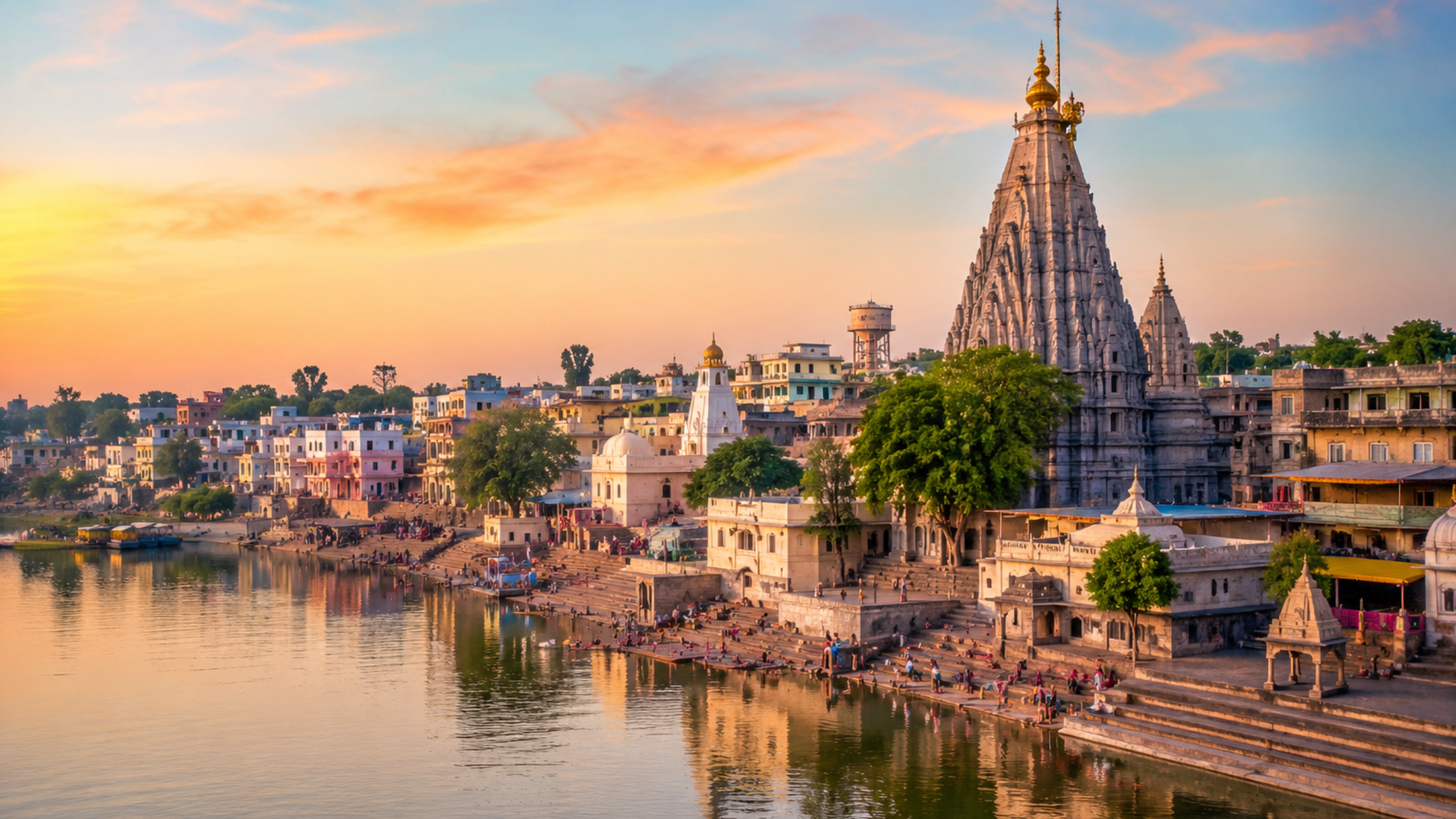
When most people hear the name Pandharpur, they think of the Shri Vitthal-Rukmini Temple, the sacred Chandrabhaga River, and the Ashadhi Ekadashi pilgrimage that draws over 28 lakh devotees every year. That identity is real and it is not going anywhere. But in 2026, Pandharpur is telling a second story, one that real estate investors and homebuyers are only beginning to read.
A Rs.4,000 crore corridor development, an incoming MIDC industrial zone, railway expansion, exponentially rising land demand, and a flat market with steady consistent buyers are converging at the same moment in a small city where entry prices are still accessible and the growth curve has barely begun. What Shirdi looked like in the early 2010s, what Nashik looked like before its grape-belt transformation, Pandharpur looks like today.
This blog breaks down the five most important reasons why Pandharpur is transitioning from a pilgrimage town into a genuine real estate investment destination, and what that means for buyers, investors, and NRIs looking at Maharashtra’s emerging markets.
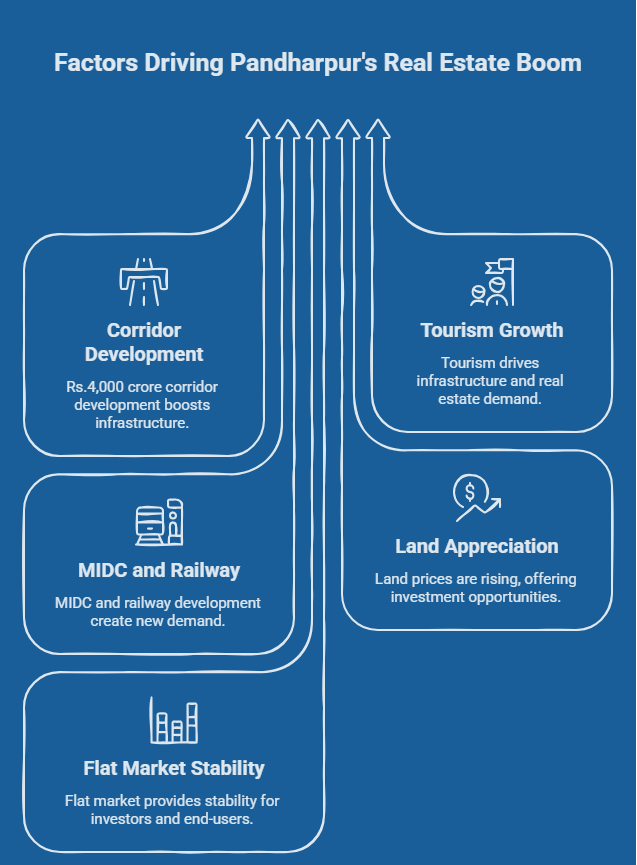
1. The Rs.4,000 Crore Corridor Development
If you are looking for one reason, just one, to take Pandharpur seriously as a real estate market, the Pandharpur Corridor Development is it. In May 2026, Chief Minister Devendra Fadnavis chaired an apex committee meeting that gave final approval to a Rs.3,993 crore development plan for the Vitthal-Rukmini Temple precinct and surrounding urban areas. This is not a proposal or a committee recommendation. It has been sanctioned, budgeted, and construction is set to begin within months of the approval.
The scope of the project is comprehensive. It covers the beautification and widening of the Chandrabhaga River ghats, the full upgrade of the pradakshina path that devotees walk around the temple, the widening of all major roads leading to the temple complex, modern queue management systems, skywalks, underground sewerage, drinking water infrastructure, trauma care facilities, modern parking spaces, Warkari shelter centers, gardens, and Santpeeths.
For real estate, the implications are direct. Properties within 1 to 2 km of the temple corridor zone are already seeing elevated buyer interest. Commercial shops facing the upgraded pradakshina path and ghat approach roads will benefit from dramatically higher footfall capacity once the infrastructure is complete. And land near the corridor, where demand is already accelerating, will continue to move as construction milestones become visible on the ground.
The most important thing to understand about infrastructure-driven real estate is the timing principle: the market begins pricing in the project from the moment of credible approval, not from the moment of completion. That credible approval happened in May 2026. The window to enter at pre-appreciation prices is open right now.
2. Tourism Is the Foundation and Infrastructure Makes It Multiply
Pandharpur’s economic foundation is not fragile. It is not dependent on a single company, a policy decision, or a market cycle. It is anchored in 800 years of uninterrupted pilgrimage tradition. The Warkari movement, one of the largest devotional traditions in Maharashtra, drives four major Ekadashi events every year to Pandharpur, with Ashadhi Ekadashi alone drawing over 28 lakh pilgrims in 2025. This is a permanent, structural, repeating demand base that does not go away between cycles.
What the corridor development does is amplify this foundation. A faith city with poor infrastructure reaches a ceiling: it can only absorb so many pilgrims comfortably, and it can only offer so many commercial services before congestion limits growth.
The Rs.4,000 crore project is designed to remove that ceiling. Wider roads, upgraded ghats, better devotee flow management, and modern facilities will allow Pandharpur to serve significantly more pilgrims per event, which directly translates to more commercial activity, more accommodation demand, and more retail consumption.
The secondary effect is the one that matters most for real estate: recreational tourism. Today, Pandharpur draws devotees. After the corridor is complete, it will begin drawing tourists who come for the heritage, the river, and the spiritual atmosphere rather than specifically for pilgrimage. This is exactly what happened in Shirdi, Vrindavan, and Kashi after their respective corridor and infrastructure upgrades.
The buyer pool widens, the rental market deepens, and commercial properties near the precinct begin serving a 12-month demand cycle rather than a 4-event-per-year spike cycle.
For homebuyers and investors, this means that the commercial property market near the temple, the rental market for pilgrim accommodation, and the hospitality-adjacent real estate segment all have a fundamentally secure demand base underneath them. The corridor development is not creating demand from scratch. It is unlocking demand that already exists at a scale the city’s current infrastructure cannot fully serve.
3. MIDC and Railway Development Are Adding an Entirely New Demand Layer
The corridor development and pilgrimage economy tell one story. But the Maharashtra Industrial Development Corporation and the upcoming railway expansion tell a completely different and equally important story. Together they represent the addition of a demand layer to Pandharpur’s real estate market that simply does not exist today: industrial workforce housing and transit-connected residential demand.
Pandharpur currently has no industrial base of any meaningful scale. That is about to change. MIDC is in the process of establishing an industrial zone in the Pandharpur region. When MIDC activates in a town of this profile, the sequence of events is well documented from comparable Maharashtra cases
. Land near the MIDC notification area moves first, often before the zone is formally operational, as investors position ahead of demand. Then affordable residential plots and 1 BHK to 2 BHK flats in the surrounding area see a demand surge from incoming supervisory and skilled-worker populations who need accommodation. Then the commercial services layer builds: dhabas, medical clinics, hardware shops, small supermarkets, and ancillary businesses serving the industrial workforce.
This sequence plays out over 3 to 5 years and delivers consistent residential appreciation across affordable price points. For a market like Pandharpur where 1 BHK flats are available from Rs.25 lakh and peripheral residential plots from Rs.2,500 per sqft, the entry threshold for investors targeting this demand wave is genuinely accessible.
The railway development layer compounds this. Pandharpur Railway Station already connects the city to Solapur, Kurduwadi, Pune, and Mumbai. Planned upgrades to frequency and station infrastructure will expand the catchment of both daily commuters and pilgrims who use rail as their primary mode of arrival. In Maharashtra’s smaller cities, railway station upgrades have consistently triggered commercial appreciation in the surrounding 500 metre belt, where food, accommodation, and retail services see the first and most direct footfall increase.
4. Land Is Rising Exponentially and the Window Is Still Open
If one data point defines Pandharpur’s current real estate story, it is this: land demand is exceptionally high and prices are rising at a rate that significantly outpaces the overall property market. While the city’s blended average appreciation sits at approximately 10% over the last three years, land values, particularly for NA approved residential plots and road touch agricultural holdings, have moved at 60 to 150% over the same period depending on location relative to the temple and infrastructure projects.
This is not speculative froth. It is fundamentals-driven. NA approved plots near the temple corridor are scarce by definition, and the corridor development has imposed further supply constraints by placing 642 properties
under a rehabilitation and acquisition process. This means the available supply of transactable NA land within 1 to 2 km of the temple is shrinking at the same time that investor demand for it is rising. That combination only goes in one direction.
On the city periphery, agricultural land with national highway frontage or proximity to the proposed MIDC zone is being accumulated by investors who understand what comes next. A specific active listing from RealEstateIndia.com illustrates this concretely: a Collector NA plot with ADTP layout approval, approximately 500 metres from the Solapur Hyderabad National Highway and near the Dhayafule Spinning Mill, is currently available. This is exactly the profile of land that MIDC-adjacent investors seek, and it is still at accessible prices today.
5. The Flat Market Offers Stability for End-Users and First-Time Investors
Not every buyer in Pandharpur is looking for land. A significant and growing segment of the market is made up of local professionals, temple trust employees, government workers, and families who want to own a home in a city that is becoming more liveable, more connected, and more prosperous.
For this buyer, Pandharpur’s flat market offers something that is increasingly rare in Maharashtra’s real estate landscape: genuine affordability combined with a functioning developer ecosystem delivering RERA registered products.
The numbers are straightforward. A 1 BHK flat in Pandharpur is available from Rs.25 lakh to Rs.38 lakh. A 2 BHK flat, the most searched configuration accounting for over 80% of buyer queries on 99acres, is available from Rs.42 lakh to Rs.45 lakh. A fully furnished ready-to-move 2 BHK has been listed at Rs.42 lakh, all-in. These are prices that are accessible to a large base of salaried buyers in the Rs.50,000 to 80,000 monthly income bracket, particularly with the home loan rates and EMI structures available in 2026.
Multiple developers are active in this space with RERA registered projects, including Shri Varad Mayuresh Residency, Tirupati Shri Audumbar Plaza, Samruddhi Samartha Residency, BSL Shrikhande Pride, Pragati Samruddhi Heights, and the newer Bhawani Srishti Pandhari.
The presence of multiple concurrent RERA projects in a city of Pandharpur’s size is a meaningful signal: it indicates that developers who operate in this market see sustained demand at current price points and are willing to commit capital to new supply.
Summary: 5 Reasons Why Pandharpur Is Emerging as a Real Estate Hotspot
| Sr No | Key Trigger | Asset Beneficiary | Investor Horizon |
| 01 | Rs.4,000 Cr Corridor (sanctioned May 2026) | Temple belt land and commercial shops | 3 to 7 years |
| 02 | Tourism economy amplified by infrastructure | Hospitality properties and ghat-facing shops | 3 to 5 years |
| 03 | MIDC and Railway bringing new demand layers | Peripheral plots and affordable flats | 4 to 7 years |
| 04 | Land demand is high and rising exponentially | NA plots, road-touch agricultural land | 5 to 10 years |
| 05 | Flat market is stable with consistent end-user demand | RERA flats and independent houses | 5 plus years |
FAQs
- Why is Pandharpur becoming a real estate investment hotspot?
Pandharpur is witnessing rapid real estate growth due to the sanctioned ₹4,000 crore corridor development, the upcoming MIDC industrial zone, railway expansion, and rising tourism. These infrastructure projects are creating strong demand for residential, commercial, and land investments. - Is it better to invest in land or flats in Pandharpur?
Both asset classes offer different advantages. Land has shown faster appreciation, especially near the temple corridor and proposed MIDC areas, while flats provide affordable entry prices, stable end-user demand, and rental income potential for long-term investors. - How will the ₹4,000 crore corridor project impact property prices in Pandharpur?
Large-scale infrastructure projects typically increase nearby property values by improving accessibility, tourism, and commercial activity. As construction progresses, properties around the temple precinct and key connecting roads are expected to witness higher demand and long-term appreciation. - Are there affordable housing options available in Pandharpur?
Yes. Pandharpur offers a range of affordable residential properties, including 1 BHK flats starting from around ₹25 lakh and 2 BHK flats from approximately ₹42 lakh, making the city attractive for first-time homebuyers and investors. - Who should consider investing in Pandharpur real estate?
Pandharpur is suitable for first-time homebuyers, long-term investors, NRIs, professionals seeking rental income, and businesses looking to benefit from the city’s expanding tourism, infrastructure, and industrial growth.
Creative Proptech Pvt Ltd is a Realty Research and Wealth Management company helping NRI investors, entrepreneurs, and organisations explore scalable real estate opportunities by combining market intelligence and technology. For investment advisory or portfolio consultation: support@creativevaluers.com | www.creativeproptech.in
Disclaimer: This blog is for informational purposes only. Property prices cited are based on active listings from 99acres.com, RealEstateIndia.com, and verified market sources as of July 2026. Past appreciation is not indicative of future returns. Verify all data independently before making investment decisions.